Search

Digital Health
MEMBERS
TOPICS
REGIONS
Webinar Series: Building Digital Health Tools That Work​

Webinar Series: Building Digital Health Tools That Work​

Digital health tools are expanding rapidly across public health systems, but having a tool isn’t the same as having one that is trustworthy, user-friendly, safe, accessible, effective, and integrated into the larger health system. This five-part webinar series, hosted by Population Services International, explores what it takes to build digital health tools that work in the real world. Drawing on perspectives from public health managers, healthcare providers, implementing partners, and civil society, the series will look at how to design tools people want to use, build them responsibly, maximise their accessibility, assess the value they create, and integrate them into health systems for sustainable scale.

GDHF 2026: Navigating the Next Wave: AI, Innovation and Health for All

GDHF 2026: Navigating the Next Wave: AI, Innovation and Health for All

For over 15 years, the Global Digital Health Forum has been the place where the people building the future of digital health come together. In December 2026, GDHF comes to Asia for the first time. Hosted in Bangkok and co-hosted by Thailand’s Ministry of Public Health with the support of WHO Thailand, this is a strategic opportunity to help shape the future of digital health across the world’s fastest-growing health technology market.

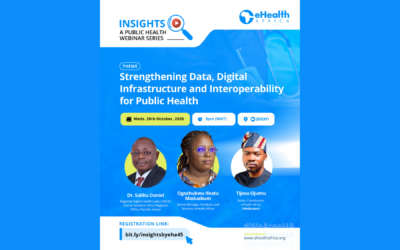
Beyond ILF 2026 Webinar Series: Strengthening Data, Digital Infrastructure & Interoperability for Public Health

Beyond ILF 2026 Webinar Series: Strengthening Data, Digital Infrastructure & Interoperability for Public Health

Building on conversations from eHealth Africa’s Insights Learning Forum (ILF) 2026, this edition of the Beyond ILF Webinar Series will bring together leading experts to explore practical pathways towards connected, interoperable and sustainable digital health systems across Africa. The discussion will examine how stronger data governance, Digital Public Infrastructure, sustainable financing, institutional ownership and strategic partnerships can help countries move beyond isolated digital solutions towards integrated health ecosystems that translate data into actionable public health intelligence.

Digital Backlash: Manifestations & Resistance with Dr. Becky Faith

Digital Backlash: Manifestations & Resistance with Dr. Becky Faith

On November 5th, 2026, the Gender, MERL, and AI Learning Group at the MERL Tech CoP will welcome Dr. Becky Faith for a conversation about her new working paper, “Digital Backlash: Manifestations and Resistance”, co-authored with Antea de Jesus Gomes and Raisa Philip. Exploring how digital systems increasingly entrench and amplify gender inequalities with minimal accountability, the working paper argues that in these same systems gender justice advocates are countering the backlash, showing how it is possible to carve out and create new technological trajectories, rooted in care and inclusive futures.

Stanford Center for Digital Health Annual Symposium

Stanford Center for Digital Health Annual Symposium

The Stanford Center for Digital Health Annual Symposium brings researchers, clinicians, and business leaders together on the Stanford campus to discuss defining opportunities of our time. The brightest minds in technology, academia, policy and medicine will participate in this all-day event. The event aims to inspire thoughtful conversations and action at the intersection of technology and health.

Digital ID Systems and Public Health in the Age of AI

Digital ID Systems and Public Health in the Age of AI

Convened by Vital Strategies under the PILLARs initiative, this 60-minute exchange on August 12 at 9:00AM ET / 6:00AM PT will bring together a small group of country representatives, regional institutions, and technical partners to explore one shared question: How are countries designing and implementing trusted and inclusive digital IDs that are rooted in CRVS systems and advance public health goals?

From Market Shaping to Market Building: What Happens When the Old Global Health Playbook No Longer Applies?

From Market Shaping to Market Building: What Happens When the Old Global Health Playbook No Longer Applies?

At the Alliance’s 2026 Annual Meeting, a panel moderated by Jessica Katz, founder and CEO of The Partnership Lab, brought together Yasmin Chandani, CEO of inSupply Health; Jayasree Iyer, CEO of the Access to Medicine Foundation; Mary-Ann Etiebet, president and CEO of Vital Strategies; and Joanna Sickler, vice-president of health policy and external affairs at Roche Diagnostics to examine how market shaping is evolving into market building amid tighter funding, geopolitical shifts, growing country ownership, and more complex health markets.

Building Country-led Ecosystems to Scale Global Health Innovation

Building Country-led Ecosystems to Scale Global Health Innovation

Join the Bay Area Global Health Alliance for a virtual convening on April 30, 2026, from 8:00–9:00am PT on “Building Country-led Ecosystems to Scale Global Health Innovation.” This discussion brings together leaders from Google Research Africa and Amp Health, moderated by eHealth Africa, to examine how locally rooted innovation ecosystems are being built — and what it takes to make them last.

AHTS x Canada 2026 — Africa’s Flagship Health Innovation Platform

AHTS x Canada 2026 — Africa’s Flagship Health Innovation Platform

The Africa HealthTech Summit (AHTSx) Canada 2026 will take place June 9–10, 2026 in Toronto. The summit will bring together leaders from across the health ecosystem—including innovators, policymakers, investors, clinicians, and researchers—to explore the future of connected care, digital health innovation, and partnerships for resilient health systems. The two-day convening will feature policy dialogues, innovation showcases, and collaboration opportunities connecting Africa, Canada, and the global health community.

Shaping the Next Global Strategy on Digital Health (2028–2033)

Shaping the Next Global Strategy on Digital Health (2028–2033)

Join the World Health Organization (WHO) for a 90-minute technical webinar dedicated to shaping the successor Global Strategy on Digital Health (2028–2033). Following the endorsement of the Seventy-eighth World Health Assembly (WHA78.22), this session marks a critical milestone in a Member State-driven process to define the future of data, digital health, and AI. This consultation will gather structured inputs to ensure the next strategy reflects diverse global needs, addresses persistent obstacles like fragmentation and limited interoperability, and aligns with broader digital cooperation processes such as the WSIS Action Line 7 on eHealth and the Global Digital Compact.

Digital Interfaces to Spur Behaviour Change in Health Among Adolescents in Kenya and Beyond

Digital Interfaces to Spur Behaviour Change in Health Among Adolescents in Kenya and Beyond

This high-impact session, co-sponsored by eHealth Africa, Reach Digital Health, the Bay Area Global Health Alliance, and PSI, will feature a youth-led section amplifying the voices and insights from young people themselves, a live product demonstration from consortium partners and a fireside chat with sector leaders. The breakfast salon is designed to spark momentum, deepen collaboration, and drive forward a shared agenda for digital health innovation that centers youth, Africa’s most powerful asset for the future.

Driving Breakthrough Innovations in Maternal Health With Digital Tools, Data, and Private Sector Collaboration

Driving Breakthrough Innovations in Maternal Health With Digital Tools, Data, and Private Sector Collaboration

Three years ago, MSD for Mothers (MfM) announced a bold new $25M initiative, Strengthening Systems for Safer Childbirth, that set out to pick up the pace in saving women’s lives and achieve Sustainable Development Goals targets to reduce maternal mortality. At the Global Digital Health Forum, this plenary session aims to spotlight the real-world impact and candid lessons learned of private sector digital solutions to advance quality maternal health across India, Nigeria, Kenya and Sierra Leone.

Insights and Learnings from Implementation of Digital Health and AI in Global Health

Insights and Learnings from Implementation of Digital Health and AI in Global Health

Building off the Global Digital Health Forum track’s theme of spotlighting the Full-STAC approach and harnessing the potential for AI in global health, this breakout session will feature real world examples and case studies from innovators who have built solutions, leveraging the full-STAC approach and AI. Geared towards developers and digital architects, this interactive session is aimed at bringing real world learnings and insights gained from real world implementations. This breakout session will be moderated by Richa Tiwari, Program Lead, Health AI, Google Research.

The Full-STAC Future: Building the Open Digital Health Ecosystem

The Full-STAC Future: Building the Open Digital Health Ecosystem

At the Global Digital Health Forum, The Full-STAC Future: Building the Open Digital Health Ecosystem panel will delve into this integrated approach to building digital public infrastructure for health. Anchored in the “Full-STAC” principles of Standards, Technologies, Architectures, Content, and Community, this track will explore how open, interoperable systems can drive more equitable, efficient, and people-centered care, primed to harness the full potential of AI.

2025 Center for Digital Health Annual Symposium

2025 Center for Digital Health Annual Symposium

The 2025 Center for Digital Health Annual Symposium will take place on October 23rd at the Frances C. Arrillaga Alumni Center. Stanford CDH aims to bring the best and brightest minds of Stanford, Silicon Valley, and the world together to solve the most pressing questions in a way that is scientifically rigorous and ethically sound.

Africa HealthTech Summit 2025

Africa HealthTech Summit 2025

The Africa HealthTech Summit (AHTS) brings together Ministers of Health and ICT, National Public Health Institutes, Regulators, Tech Innovators, Healthcare Professionals, Development Partners, Investors, and Academia. Together, they explore how emerging technologies can be harnessed to build resilience, improve health systems, and promote individual wellbeing across African communities.